
Lucky 15 and Non-Runners — Rules, Scenarios and Adjusted Returns
 Available in US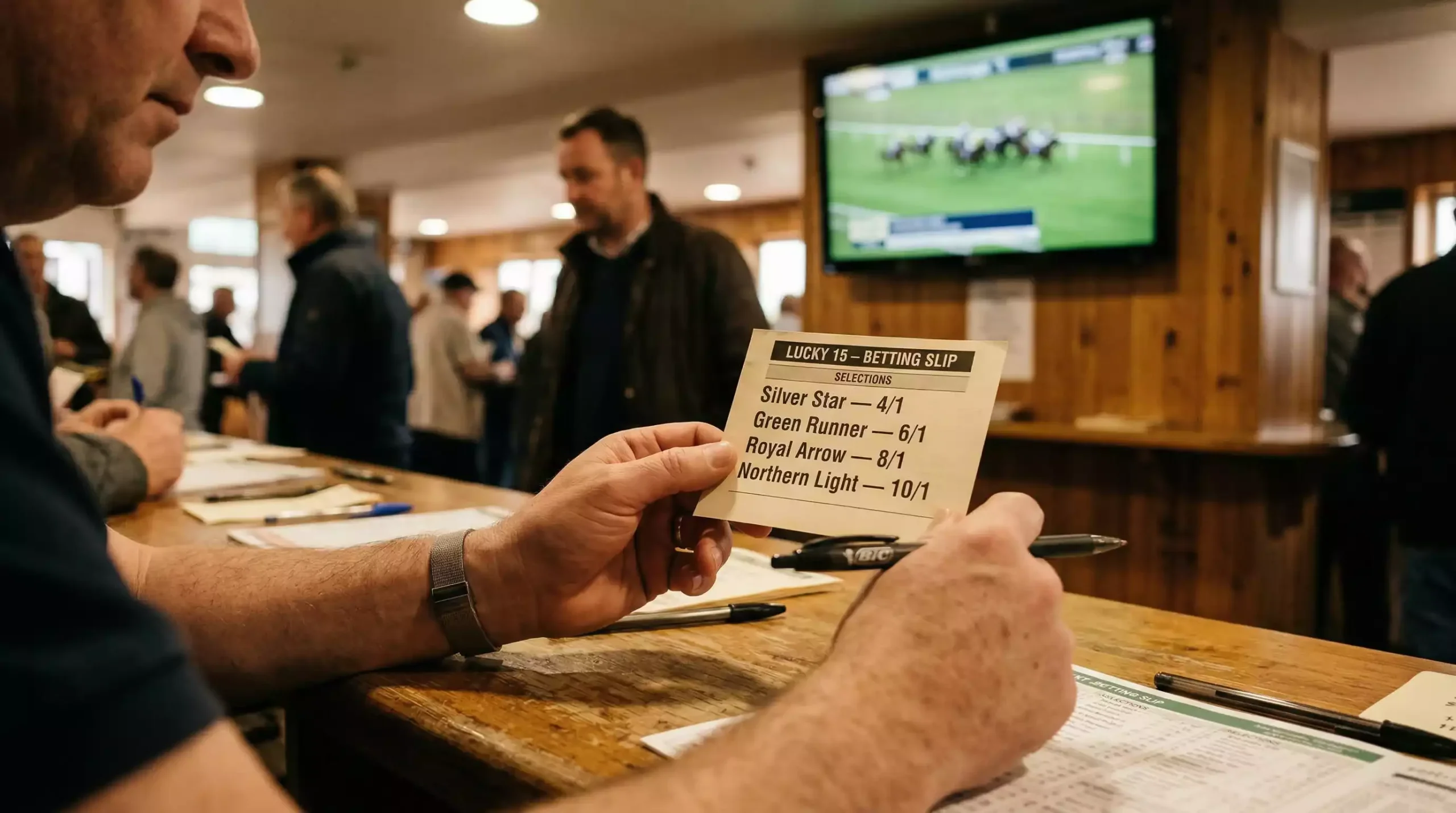
Fifteen bets, four horses — and one gap changes everything. A Lucky 15 is one of the most popular full-cover bet types in British racing: four singles, six doubles, four trebles, and one four-fold, totalling fifteen individual bets from four selections. When all four horses run, the maths is clear. When one of them is declared a non-runner, the cascade begins — and it touches far more than a single bet.
The UK horse racing betting market generated £766.7 million in gross gambling yield in the 2024–2025 financial year, according to the Gambling Commission. Full-cover bets like Lucky 15s, Yankees, and Lucky 31s represent a significant share of that turnover, particularly among recreational bettors who enjoy the combination of multiple selections with the possibility of consolation returns from just one winner. A non-runner in a Lucky 15 does not simply void one bet — it restructures the entire wager, changes the number of bets, and may affect whether you qualify for consolation bonuses.
Understanding how non-runners interact with the Lucky 15 structure is the difference between knowing what to expect from your settlement and wondering why the bookmaker paid less than you calculated on the back of an envelope.
Lucky 15 and Non-Runners — More on this topic at non runners today racing.
Lucky 15 Structure — Why One NR Affects More Than One Bet
A Lucky 15 consists of fifteen bets across four selections (call them A, B, C, and D). The breakdown: four singles (A, B, C, D), six doubles (AB, AC, AD, BC, BD, CD), four trebles (ABC, ABD, ACD, BCD), and one four-fold (ABCD). If you place a £1 Lucky 15, your total stake is £15 — £1 on each of the fifteen bets.
Every one of those fifteen bets includes at least one of your four selections. This means that when Horse A becomes a non-runner, every bet that includes Horse A is affected. That is not just the single on A. It is also the three doubles that include A (AB, AC, AD), the three trebles that include A (ABC, ABD, ACD), and the four-fold (ABCD). In total, eight of the fifteen bets contain the non-runner. Only seven survive intact: the singles on B, C, and D, the three doubles among B, C, and D, and the treble BCD.
The eight affected bets are not lost — they are restructured. Each one is reduced to the next fold down because the non-runner leg is voided. The double AB becomes a single on B. The treble ABC becomes a double BC. The four-fold ABCD becomes a treble BCD. Your Lucky 15 has effectively become a different bet: seven original bets unchanged, plus eight downgraded bets that now duplicate some of the original combinations.
The practical effect: your Lucky 15 with one non-runner behaves like a heavily weighted Lucky 7 (Goliath structure) on the remaining three selections. You have multiple overlapping bets on B, C, and D — more exposure to each than you originally intended, because the void leg folded its weight into the surviving combinations. The total stake remains £15 (you already paid it), but the bet no longer has the balanced four-horse structure you designed.
NR Scenarios — One NR, Two NR, Consolation Bonus Impact
One non-runner. Horse A is scratched. Your Lucky 15 becomes a restructured bet on B, C, and D. The single on A is voided — stake returned for that £1 bet, or in some bookmaker systems, the void is absorbed into the restructured Lucky 15 settlement. The eight bets containing A are reduced by one fold each. If B, C, and D all win, you collect on all seven original bets plus the eight downgraded bets — but the downgraded bets pay at reduced folds. Your four-fold has become a treble, your trebles have become doubles, and your doubles have become singles. The total payout is lower than an all-four-winner Lucky 15 because the fold reduction means smaller multipliers.
Rule 4 can compound the reduction. If another horse in one of B, C, or D’s races also has a non-runner, the Rule 4 deduction scale — running from 5p to 90p in the pound — applies within the surviving legs. The deduction is calculated on each individual bet within the Lucky 15, not on the total. A 25p Rule 4 in Race B reduces the profit on every bet that includes B, whether it is a single, a double, or the surviving treble.
Two non-runners. Horses A and B are both scratched. Now the restructuring is more severe. Every bet containing A, B, or both is affected — which is thirteen of the fifteen bets. Only two survive untouched: the single on C and the single on D. The double CD remains as originally structured. Everything else is downgraded: trebles become singles, the four-fold becomes a double, doubles containing A or B become singles. Your Lucky 15 has effectively collapsed into a collection of singles and one double on C and D. The total payout potential drops dramatically.
Three non-runners. Horses A, B, and C are all withdrawn. Fourteen of the fifteen bets are affected. The only original bet that survives is the single on D. Every other combination is either voided entirely (bets that included only the three non-runners, such as the treble ABC) or reduced to a single on D. Your Lucky 15 has become a cluster of singles on one horse. If D wins, you collect on the surviving single and the downgraded remnants — but the payout bears no resemblance to the original Lucky 15 structure.
Consolation Bonuses and NR — Do You Still Qualify?
Most bookmakers offer consolation bonuses on Lucky 15 bets: a percentage uplift on returns if only one of your four selections wins, and a larger bonus if all four win. The standard structure is a treble-the-odds consolation for one winner and a percentage bonus (typically 10% or 20%) on total returns if all four win. These bonuses are one of the main reasons bettors choose a Lucky 15 over placing four separate singles.
See also Void Bets and Non-Runners.
A non-runner complicates the bonus calculation. The consolation bonus for “one winner from four” requires four runners. If one horse is a non-runner, you effectively have three runners, and the bookmaker may argue that the consolation terms no longer apply because the bet is no longer a true four-selection Lucky 15. Some bookmakers honour the consolation on the restructured bet; others do not. The terms vary between firms, and this is an area where checking the specific bookmaker’s Lucky 15 rules before the races run can prevent an unpleasant surprise.
The all-four-winners bonus is even more directly affected. If one selection is a non-runner, you cannot have all four winners — the maximum is three. The bonus does not apply. This is straightforward and consistent across all bookmakers. The consolation for one winner, however, is the grey area, and the bookmaker’s terms are the only reliable guide.
The practical takeaway: non-runners in a Lucky 15 do not just reduce your folds and lower your potential payout. They can also strip the consolation bonuses that made the bet attractive in the first place. If one of your four selections is in a race where a non-runner is likely — a big-field handicap with shaky ground, for example — consider whether the Lucky 15 structure is the right bet type, or whether four individual singles (each with its own clear settlement rules) would give you more control over the outcome.
