
How Going Changes Cause Non-Runners — Ground Conditions Explained
 Available in US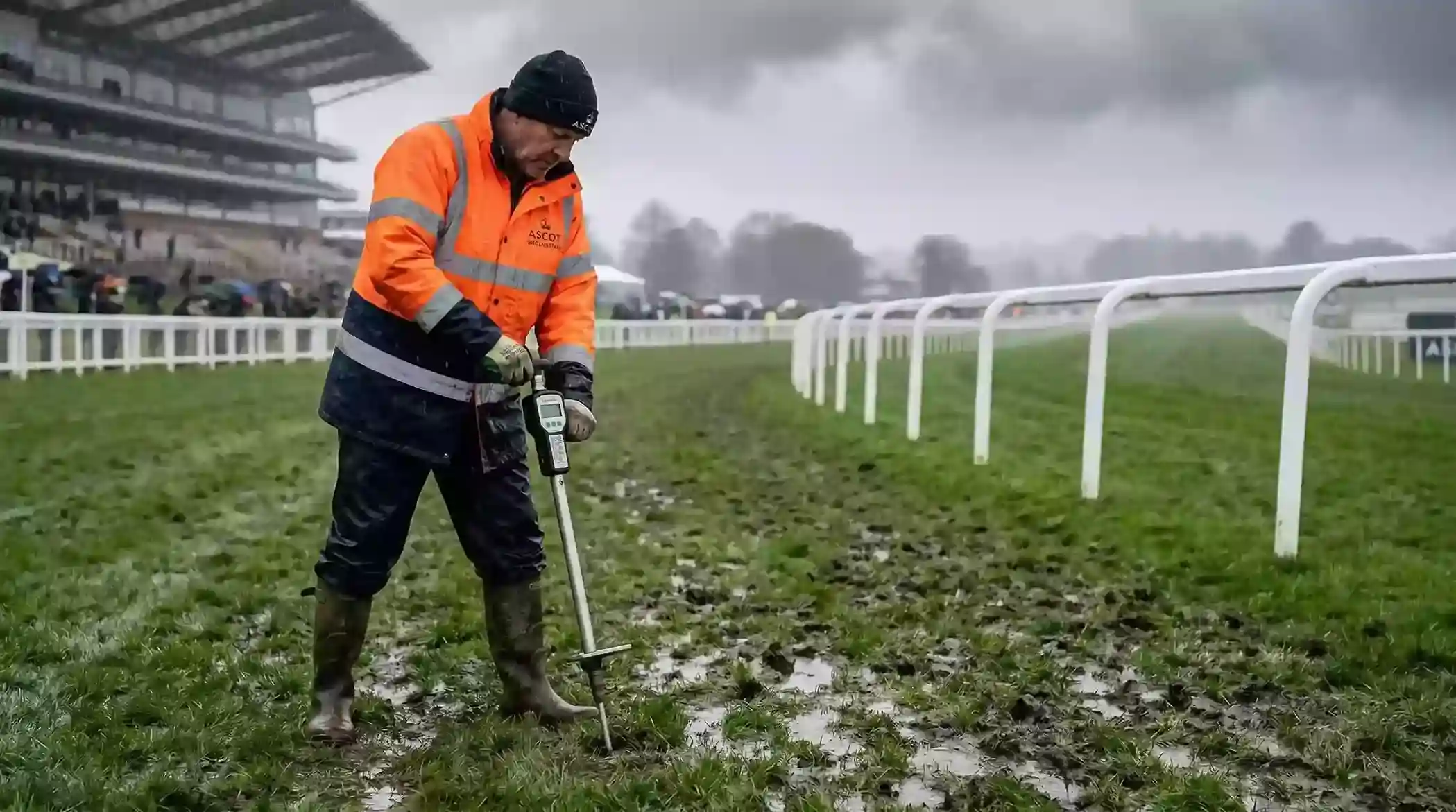
The going stick reads 6.2 — and three trainers pull their horses. The number means nothing to most bettors, but to the trainer standing in the weighing room it translates into a specific surface: the ground is on the soft side of good, with enough moisture to make it testing for horses that prefer faster conditions. Three phone calls to Weatherbys later, three horses are scratched from the card. The ground shifted — the field shrank.
Ground conditions are the single biggest driver of non-runners in UK racing. During the first quarter of 2024, 78% of fixtures were run on soft or heavy ground, according to the BHA Racing Report November 2024. The three-year average for that period is 48%. That winter’s persistent rain produced waterlogged tracks, reduced field sizes, and a spike in withdrawals that showed up in every metric the BHA publishes. The connection between going and non-runners is not a theory — it is the most documented pattern in British racing data.
Understanding how going is measured, why it triggers withdrawals, and what the data says about the correlation gives bettors a tool that most ignore: the ability to predict non-runners before they are announced, simply by reading the weather forecast and the going report.
How Going Changes Cause Non-Runners — More on this topic at non runners today racing.
How Going Is Measured — GoingStick, Visual Inspection, Official Description
The official going description in British racing is determined by the clerk of the course, using a combination of instrument readings and visual inspection. The primary instrument is the GoingStick — a handheld device that measures the shear strength and penetration of the turf. The clerk walks the course, taking readings at multiple points, and the results produce a numerical value that corresponds to a going description on the standard scale.
The scale runs from hard at the top to heavy at the bottom: hard, firm, good-to-firm, good, good-to-soft, soft, soft-to-heavy, heavy. Each description covers a range of GoingStick readings. A reading of 8.0 or above is firm. Between 6.5 and 8.0 is good-to-firm. Between 5.5 and 6.5 is good. Below 5.5, the ground moves into soft territory. The clerk also considers visual factors — the amount of standing water, the condition of the turf after gallops, the weather forecast for the period between inspection and racing — and can adjust the official description accordingly.
Going reports are published on the BHA website and distributed to racecards, bookmakers, and media outlets. The first report for a meeting typically appears two or three days before race day, with updates following as conditions change. On race day itself, the clerk may update the going description multiple times — particularly if rain falls between races — and each update can trigger a new wave of non-runner declarations.
The measurement system is imperfect. GoingStick readings can vary across different parts of the same course. The inside rail may ride softer than the stands’ side. The ground at the start may differ from the ground on the home turn. Trainers who walk the course themselves — or send a representative to do so — sometimes reach a different conclusion from the official description. A going description of “good-to-soft” might feel soft in one area and good in another, and a trainer who trusts the soft patches more than the official label may withdraw a horse that the going report suggests should run.
Trainer Decision-Making — Why a Going Change Triggers a Withdrawal
A trainer’s decision to withdraw a horse because of the going is rarely impulsive. It reflects a calculation that weighs the horse’s ground preference, its physical soundness, its career trajectory, and the trainer’s own non-runner rate against the BHA thresholds.
The BHA monitors non-runner rates quarterly. Trainers who exceed a 12% withdrawal rate on the Flat or 9% on Jumps risk losing their self-certification privileges. That penalty — requiring a veterinary certificate for every future non-runner declaration — adds cost, delay, and administrative burden. Trainers are therefore careful about which withdrawals they make. A going-related scratch costs them a percentage point on their quarterly rate, and they need to be confident that the withdrawal is justified before using one of their allowance.
The primary justification is the horse’s wellbeing and competitive prospects. A horse with a known preference for good ground will struggle on soft — it may lose its action, fail to quicken, or simply not handle the deeper surface. Running it anyway risks a poor performance that drops its handicap mark, damages its confidence, and potentially causes injury. For a trainer managing a string of horses across a season, one bad run on unsuitable ground can set a horse back weeks or months. The withdrawal is a long-term investment in the horse’s career, even though it costs one race and one entry on the non-runner list.
Some trainers are more sensitive to going changes than others. Flat trainers with large strings of well-bred horses tend to have tighter ground preferences — many of their horses are bred for speed on fast surfaces and are genuinely unsuited to soft going. Jump trainers, whose horses routinely encounter soft and heavy ground through the winter, tend to have a wider tolerance. But even in the Jumps ranks, a sudden shift to heavy ground at a track with a history of testing conditions can produce a wave of withdrawals from trainers who feel the surface has crossed from soft to unsafe.
Going and NR Correlation — The Data Behind the Pattern
The data connecting going conditions to non-runner rates is unambiguous. When the ground is soft or heavy, more horses are withdrawn. The relationship is not linear — a slight change from good to good-to-soft produces fewer withdrawals than a shift from soft to heavy — but the direction is consistent across every season in the BHA’s records.
See also Trainer Non-Runner Statistics.
The 2024 data makes the case clearly. With 78% of fixtures running on soft or heavy ground in the first quarter, field sizes shrank, non-runner rates spiked, and the BHA’s quarterly report flagged the pattern explicitly. By contrast, the summer months — when the Flat season peaks and the going is typically good or faster — produce lower non-runner rates and larger fields. The seasonal rhythm of British racing maps directly onto the going cycle: wet winters mean more non-runners, dry summers mean fewer.
For bettors, the correlation is actionable. If the going report shifts towards soft on the morning of a meeting, expect the non-runner list to grow — particularly in Flat races and in races involving horses with strong ground preferences. If the forecast is dry and the going is good-to-firm, the non-runner risk is lower and the fields are more likely to hold their overnight shape. Checking the going report is not an optional extra. It is the single most reliable indicator of whether the field you studied last night will be the field that lines up this afternoon.
The pattern also has implications for seasonal betting strategy. In the winter Jumps season, when soft and heavy ground predominates, building going-sensitivity into your selection process reduces the chance of backing a horse that gets scratched. If a horse has never run on heavy ground and the going is officially heavy, the withdrawal risk is high regardless of the horse’s other credentials. In the summer, the risk inverts: horses that need a cut in the ground are vulnerable to withdrawal on fast surfaces. Reading the going is reading the non-runner risk — and acting on it before the market does is the edge.
