
Non-Runners and Each-Way Betting — Adjusted Terms After a Withdrawal
 Available in US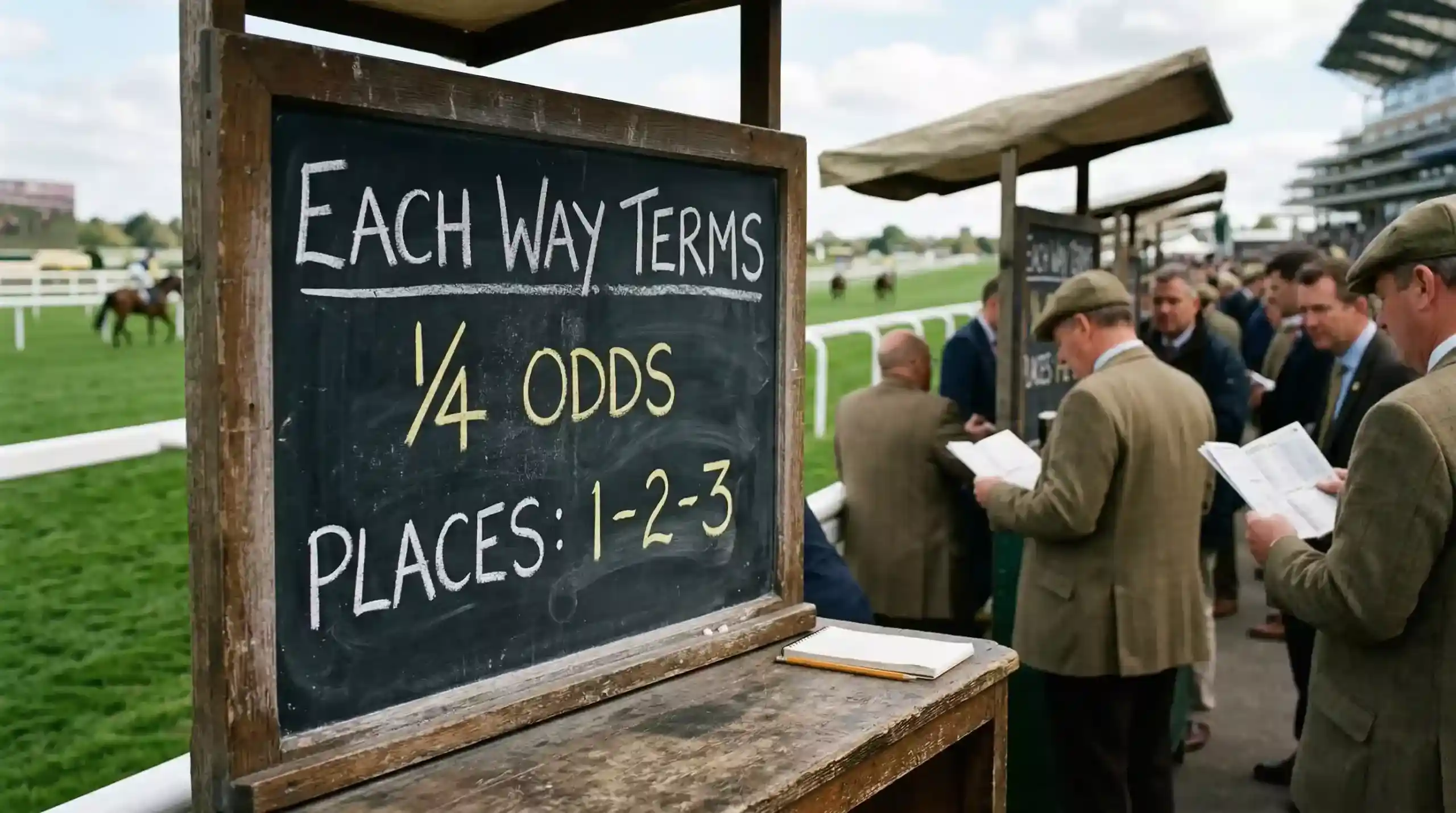
A non-runner can cut the place terms on your each-way bet. Fewer runners, fewer places — and your each-way shrinks. You placed £5 each-way on a 10/1 shot in a twelve-runner handicap, expecting three places at one-quarter the odds. Two horses are scratched. The field drops to ten. The bookmaker adjusts the each-way terms: still three places, but now at one-fifth the odds instead of one-quarter. Your place part just got less valuable, and the Rule 4 deduction on the win part has not even been applied yet.
Each-way betting is the most popular bet type in UK horse racing after the straight win single. It offers a safety net — your horse does not need to win for you to collect, only finish in the places. But that safety net has strings attached, and non-runners can pull them. Field size determines how many places are paid and at what fraction, and when non-runners reduce the field below the thresholds that govern those terms, the adjustment hits your potential return from two directions simultaneously.
Average field sizes on Core Flat fixtures in 2025 stood at 8.54, with Core Jumps at 7.63, according to the BHA Racing Report Q3 2025. In fields that are already trending smaller, each non-runner moves the field closer to the thresholds where each-way terms change — and understanding where those thresholds sit is the first step to knowing what your bet is actually worth after a withdrawal.
Non-Runners and Each-Way Betting — More on this topic at non runners today racing.
Each-Way Terms — How Place Fractions and Number of Places Work
An each-way bet is two bets in one: a win bet and a place bet, at equal stakes. If you place £5 each-way, your total stake is £10 — £5 on the horse to win and £5 on the horse to finish in the places. The place part pays a fraction of the win odds, and the number of places paid depends on the size of the field and the type of race.
The standard each-way terms in British racing follow a fixed structure. In non-handicap races with five to seven runners, two places are paid at one-quarter the odds. With eight or more runners, three places are paid at one-quarter the odds. In handicap races with sixteen or more runners, four places are paid at one-quarter the odds (some bookmakers extend this to one-fifth). In races with four or fewer runners, no each-way terms are offered — the bet is win only.
The place fraction — one-quarter, one-fifth, or occasionally one-third — determines how much the place part of your bet is worth. At 10/1 with one-quarter odds, the place pays at 10/4, or 5/2. At one-fifth odds, the same horse pays at 10/5, or 2/1. The difference between a quarter and a fifth of the odds is significant: on a £5 place stake, the return drops from £17.50 to £15. Scale that across a season of each-way bets and the cumulative effect is substantial.
These terms are set at the time of the bet, based on the declared field. But — and this is the critical point — they can be adjusted after the bet is placed if non-runners reduce the field below the thresholds that determine the terms. Your bet was placed under one set of conditions. The settlement may happen under a different set.
How Non-Runners Change Each-Way Terms — Fewer Places, Smaller Fractions
When non-runners reduce the field, bookmakers adjust the each-way terms to reflect the new number of runners. The adjustment typically follows the standard thresholds: if the field drops from eight to seven, the number of places may remain at two instead of three. If it drops from seven to four, each-way terms may be withdrawn entirely.
The most common adjustment is a reduction in the number of places paid. You placed your bet when the field had nine runners and three places. Two non-runners reduce the field to seven. The bookmaker may now pay only two places. If your horse finishes third, you lose the place part of the bet — a finish that would have collected under the original terms now returns nothing on the place side.
The place fraction can also change. Some bookmakers reserve the right to reduce the fraction from one-quarter to one-fifth when non-runners shrink the field. This adjustment is less visible than a place reduction — your horse still finishes in the places and you still collect — but the return is smaller. A 10/1 shot paying at one-quarter odds returns £17.50 on a £5 place stake. At one-fifth, the same finish returns £15. The difference is £2.50 per bet — modest in isolation, painful in aggregate.
Rule 4 compounds the effect. A non-runner triggers both a Rule 4 deduction on the win and place parts of your bet and a potential adjustment to the each-way terms. The deduction scale — 5p to 90p in the pound — applies independently to each part. If the non-runner was priced at 3/1 (25p deduction), the win profit is reduced by 25% and the place profit is reduced by 25%, on top of any change to the place fraction or number of places. The two mechanisms stack: Rule 4 reduces the value of each part, and the term adjustment reduces the value of the place part further.
Consider a worked example. You placed £5 each-way on a 8/1 shot in a nine-runner handicap. Original terms: three places at one-quarter odds. A non-runner at 2/1 (30p deduction) reduces the field to eight. Terms hold at three places, one-quarter odds — the threshold was not breached. Your horse wins. Win profit: £40 minus 30% Rule 4 = £28. Place profit: £10 minus 30% = £7. Total return: £28 + £7 + £10 stake = £45. Without Rule 4, the return would have been £60. Now suppose a second non-runner reduces the field to seven. The bookmaker adjusts to two places at one-quarter odds. If your horse finishes third, the place part returns nothing — two places only, third is out. The compounding of Rule 4 and term adjustment has stripped value from both sides of the bet.
Protecting Your Each-Way Bet — NRMB, Early Prices, and Timing
The most effective protection for each-way bets in non-runner-prone races is timing. If you wait until the final field is confirmed before placing your bet, the each-way terms you see are the terms you get. No adjustment, no surprise reduction in places or fractions. The trade-off is price — waiting means you may miss a longer early price — but the certainty of knowing exactly what your bet is worth is often more valuable than an extra point of odds on a bet that might be restructured after a withdrawal.
See also Tattersalls Committee Rules.
NRMB offers protect against your own selection being withdrawn but do not protect against the each-way term adjustments caused by other non-runners. If your horse is scratched, NRMB refunds your stake. If a different horse is scratched and the field drops below a threshold, your each-way terms may change — and NRMB does not cover that scenario. The protection is selection-specific, not market-wide.
In races where the field is already close to a term threshold — eight runners, for example, sitting on the boundary between three places and two — the non-runner risk to your each-way bet is highest. One withdrawal changes the terms. In these marginal situations, placing a win-only bet and skipping the each-way may be the cleaner approach, particularly if the horse’s form suggests it is a win-or-bust proposition rather than a place contender. The each-way safety net is only valuable when the terms that define it are stable — and in a shrinking field, stability is the first thing that goes.
