
Best Odds Guaranteed and Non-Runners — How BOG Interacts with Rule 4
 Available in US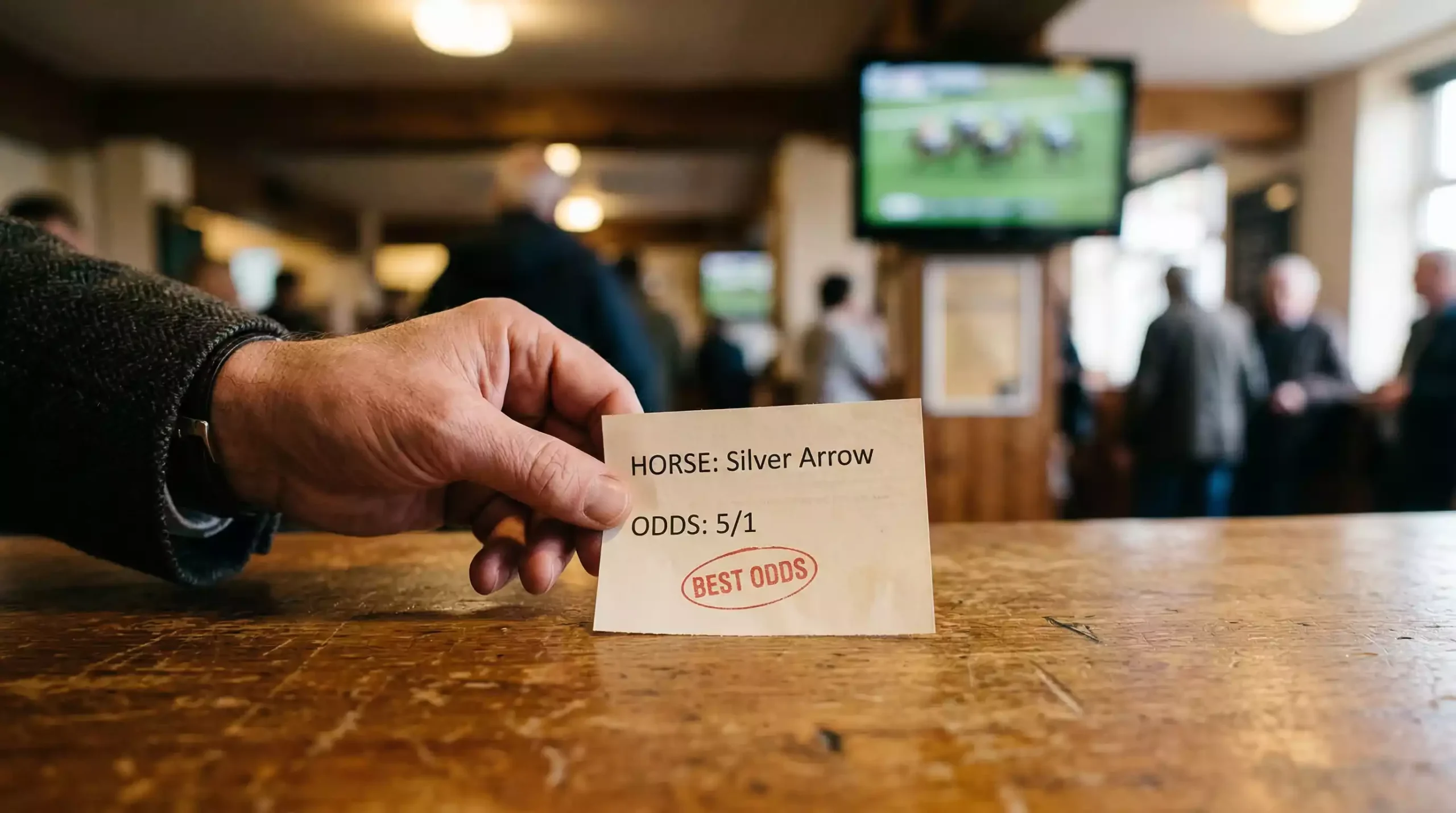
BOG protects your price — Rule 4 still cuts your payout. That is the sentence most bettors do not hear until the settlement lands in their account and the number is lower than expected. Best Odds Guaranteed is one of the most popular promotions in UK horse racing, offered by virtually every major bookmaker. It guarantees that if you take an early price and the Starting Price is higher, you are paid at the bigger number. It sounds like total protection. It is not.
The gap in the armour is Rule 4. When a non-runner is declared, the deduction applies to whichever price you are paid at — early price or SP. BOG decides which price is better. Rule 4 then reduces the profit from that price. The two mechanisms operate in sequence, not in opposition, and the result is a payout that can feel unexpectedly low even though both the BOG upgrade and the Rule 4 deduction were applied correctly.
The Rule 4 deduction scale runs from 5p to 90p in the pound, determined by the withdrawn horse’s price at the time of removal. In a market where remote horse racing betting generated £766.7 million in gross gambling yield during the 2024–2025 financial year, according to the Gambling Commission, the interaction between BOG and Rule 4 affects a substantial volume of bets. Understanding how the two work together — and where they do not — is essential for any bettor who takes early prices.
Best Odds Guaranteed and Non-Runners — More on this topic at non runners today racing.
How Best Odds Guaranteed Works — The Promise and the Limits
Best Odds Guaranteed is a promotion that applies to bets placed at a fixed price before the race. If the Starting Price at the off is higher than the price you took, the bookmaker pays you at the SP instead. If the SP is lower, you keep your original price. You always get the better of the two.
The promotion is designed to remove the fear of “taking a price too early.” Without BOG, a bettor who takes 5/1 in the morning and watches the horse drift to 7/1 by the off has left value on the table. With BOG, that drift is captured automatically — the bookmaker pays at 7/1 even though you took 5/1. The reverse — where the horse shortens from 5/1 to 3/1 — does not hurt you either, because BOG guarantees your original 5/1.
The limits of BOG are important. Most bookmakers apply it only to UK and Irish horse racing on the day of the race. Ante-post bets are excluded. Some firms impose a maximum payout or a maximum stake eligible for the BOG upgrade. Others exclude specific race types — all-weather meetings, for example, or races after a certain time in the evening. The promotional terms vary, and checking them before the season starts is worth the effort.
BOG does not interact with NRNB. If your horse is a non-runner and you have both BOG and NRNB on the same bet, the NRNB stake refund takes priority — the bet is voided, and BOG becomes irrelevant because there is no winning price to compare. BOG only matters when your horse runs and wins. It is a price-protection mechanism, not a non-runner protection mechanism. That distinction is where the confusion begins.
BOG + Rule 4 — The Interaction That Catches People Out
Here is where bettors get caught. You take an early price of 5/1. A rival is withdrawn, and Rule 4 applies. The SP of your horse drifts to 7/1 because the non-runner shortened the field and the market adjusted. BOG kicks in and pays you at 7/1 — the better price. But Rule 4 then deducts from the 7/1 payout, not from the 5/1 price you originally took.
The deduction is based on the non-runner’s price at the time of withdrawal, not on your selection’s price. If the non-runner was priced at 3/1, the deduction is 25p in the pound. On a £10 bet at 7/1 (BOG-upgraded from 5/1), your gross profit is £70. The deduction is £70 × 0.25 = £17.50. Your adjusted profit is £52.50, and your total return is £62.50. Without BOG, you would have been paid at 5/1 with the same Rule 4: £50 profit minus £12.50 deduction = £37.50 profit, or £47.50 total. BOG added £15 to your return — but Rule 4 took £17.50 from the BOG-upgraded price. The net benefit of BOG in this scenario is real but smaller than the headline 7/1 vs 5/1 comparison suggests.
The interaction catches people because the two mechanisms operate independently. BOG compares your early price to the SP and pays the higher. Rule 4 then applies to whatever price you are paid at. The bookmaker does not subtract Rule 4 from your original price and then apply BOG to the result — it works the other way around. BOG first, Rule 4 second. This sequence means that the Rule 4 deduction is always calculated on the larger profit figure, which produces a bigger absolute deduction than if Rule 4 had been applied to the original early price.
BHA Chief Regulatory Officer Brant Dunshea has described the fair-start rule changes introduced since 2024 as positive for bettors, noting that stewards now have powers to protect punters in scenarios that previously left them without recourse. That regulatory direction towards more bettor-friendly outcomes is a separate protection from BOG — it deals with whether a horse is classified as a non-runner at all, not with how the price is calculated afterwards. BOG and Rule 4 sit in the commercial layer between punter and bookmaker. The BHA’s non-runner rules sit in the regulatory layer above both.
Scenarios — BOG Helps, BOG Doesn’t Help, BOG + NR
Scenario one: BOG helps, no non-runner. You take 4/1 in the morning. The horse drifts to 6/1 by the off. No non-runners in the race. BOG pays you at 6/1. Your £10 bet returns £70 instead of £50. Clean benefit, no complications. This is BOG working as advertised.
See also Non-Runners on Betfair Exchange vs Bookmakers.
Scenario two: BOG helps, non-runner declared. You take 4/1. A rival at 2/1 is withdrawn (30p deduction). Your horse drifts to 6/1 SP. BOG pays at 6/1. Gross profit: £60. Deduction: £60 × 0.30 = £18. Adjusted profit: £42. Total return: £52. Without BOG, you would have been paid at 4/1: £40 profit, minus £12 deduction (£40 × 0.30), equals £28 profit and £38 return. BOG added £14 to your return — a meaningful improvement, though the 30p deduction still bit into both prices.
Scenario three: BOG does not help. You take 6/1. The horse shortens to 4/1 SP. No non-runner. BOG does not trigger because your early price is already better than the SP. You are paid at 6/1. Return: £70. BOG is irrelevant here — it only activates when the SP exceeds your early price.
Scenario four: BOG does not help, non-runner declared. You take 6/1. A rival at 5/1 is withdrawn (15p deduction). Your horse shortens to 4/1 SP. BOG does not trigger — your 6/1 is still better. Rule 4 applies to the 6/1 price: £60 profit, minus £9 deduction, equals £51 profit. Total return: £61. In this case, the non-runner shortened your horse’s SP but your locked-in early price was already better. BOG played no role, and Rule 4’s impact was modest because the non-runner was mid-priced.
The pattern across all scenarios: BOG never hurts you. It either helps or does nothing. But Rule 4 always applies when a non-runner is declared and you took a fixed price, and the deduction is calculated on whichever price you are paid at — including the BOG-upgraded price. Treating BOG as non-runner protection is the mistake. It protects your price. It does not protect your payout from deductions.
