
Non-Runners on Betfair Exchange vs Bookmakers — Two Systems, Two Outcomes
 Available in US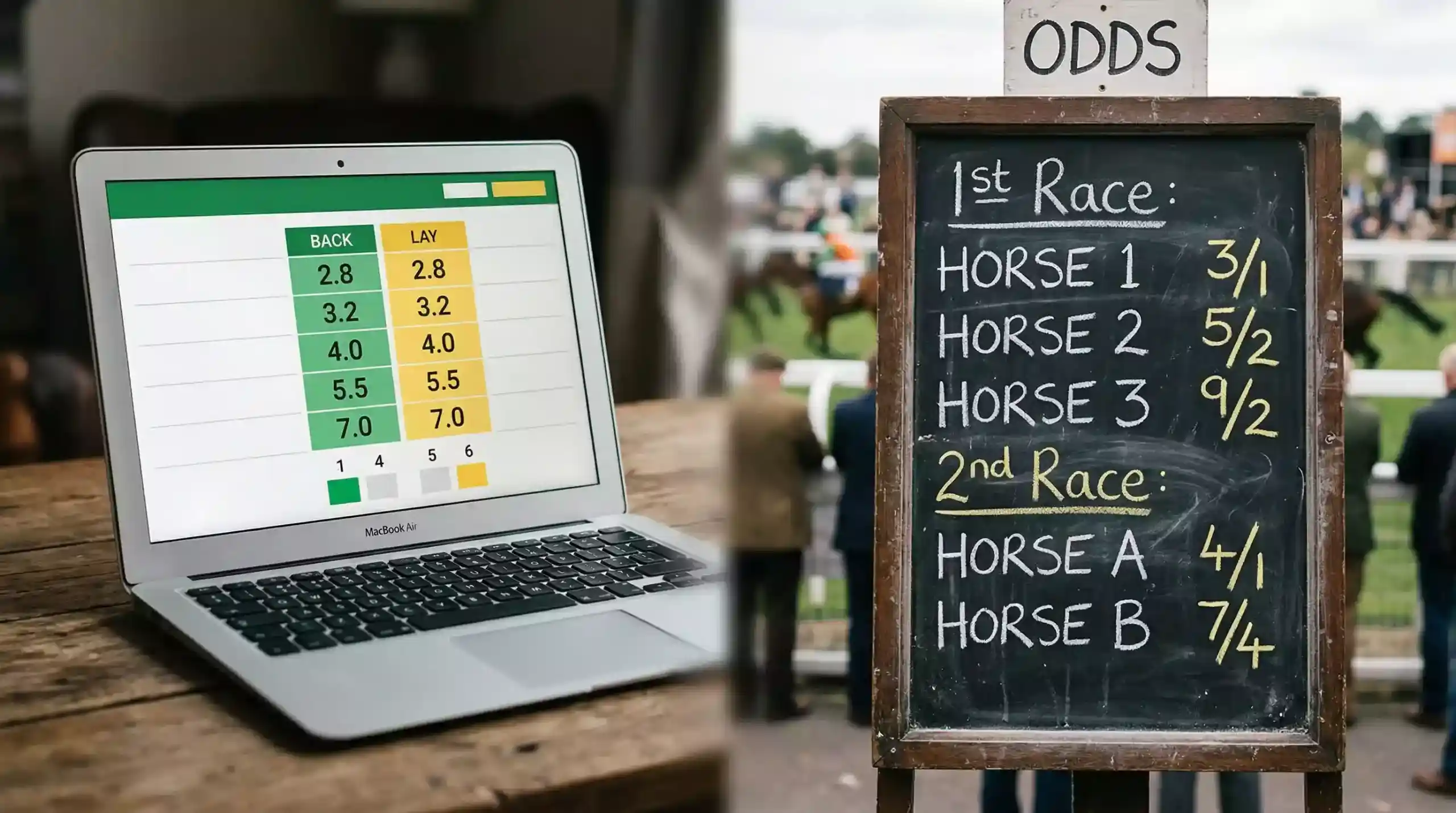
Same non-runner, different maths. A horse is withdrawn from the 3:15 at Newbury. On Betfair Exchange, your bet is adjusted by the reduction factor — a percentage-based cut to your odds that reflects the non-runner’s share of the market. At your bookmaker, the same withdrawal triggers a Rule 4 deduction — a fixed pence-in-the-pound cut from your profit based on the non-runner’s price. Both systems aim to compensate for the shorter field. Both produce a different number on your payout.
The difference is not trivial. Depending on what you backed and at what price, the exchange reduction factor can leave you better off or worse off than Rule 4. A short-priced horse withdrawn from a small field hits harder on the exchange for long-odds selections. The same withdrawal at a bookmaker hits every winner equally, regardless of the price they backed. The system you bet through determines your return — and most punters use both without realising how differently they treat the same event.
If the non-runner’s reduction factor on Betfair falls below 2.5%, no adjustment is made at all. The horse was too insignificant to move the market. Under Rule 4, even an outsider at 10/1 to 14/1 triggers a 5p deduction. That threshold gap is the first structural difference — and it sets the tone for everything that follows.
Non-Runners on Betfair Exchange vs Bookmakers — More on this topic at non runners today racing.
How Betfair Handles a Non-Runner — Reduction Factor in Practice
When a non-runner is declared on Betfair, the market is suspended. All unmatched bets are cancelled. Betfair then applies the withdrawn horse’s reduction factor to every matched bet in the market. The formula adjusts each bet’s effective odds: take the decimal odds, subtract one, multiply by the reduction factor as a decimal, and subtract the result from the original odds. Trading resumes at the new prices.
The reduction factor is assigned when the market opens and does not change during trading. It represents the horse’s implied probability of winning at the point the market was formed. A 3/1 shot might carry a reduction factor of around 25%. A 10/1 outsider might sit at 8%. A 50/1 no-hoper might carry 2% — below the 2.5% threshold, meaning its withdrawal changes nothing.
The adjustment is proportional to your bet’s odds. If you backed a horse at decimal 4.0 (3/1) and the non-runner’s reduction factor is 25%, the reduction is (4.0 − 1) × 0.25 = 0.75. Your effective odds become 3.25. If you backed a horse at decimal 11.0 (10/1), the reduction is (11.0 − 1) × 0.25 = 2.50. Your effective odds become 8.50. The longer your price, the bigger the absolute reduction — because the non-runner’s probability is redistributed proportionally across the remaining field.
Betfair adjusts both back and lay bets. If you laid a horse, your liability decreases proportionally after the reduction factor is applied. This symmetry is a feature the bookmaker model does not share — Rule 4 only affects backers. On the exchange, every participant is treated equally after a withdrawal.
How Bookmakers Handle a Non-Runner — Rule 4 in Practice
At a traditional bookmaker, the process is simpler in structure but less transparent in execution. When a non-runner is declared, the bookmaker removes the horse from the racecard. If you backed the non-runner, your bet is voided and your stake returned. If you backed another horse, your bet survives but is subject to a Rule 4 deduction calculated on the withdrawn horse’s price at the time of removal.
The deduction is flat. It does not scale with the price of your selection — it is the same pence-in-the-pound figure whether you backed the favourite or a 20/1 outsider. A non-runner at 3/1 triggers a 25p deduction on every winning bet in the race. Your £50 profit loses £12.50 regardless of whether your horse was 2/1 or 12/1. This uniformity is the defining feature of Rule 4: it treats all backers identically, based solely on the non-runner’s price.
The deduction is applied after the race. You do not see the adjusted odds on your betslip before the off — the settlement reflects the Rule 4 deduction only once the race is run and the result is official. This means you cannot trade out of the position before the race. On the exchange, the reduced odds are visible immediately after the non-runner is announced, and you can choose to lay off or adjust your position. At a bookmaker, you wait, watch the race, and discover the deduction when the bet settles.
Rule 4 does not apply to bets placed after the non-runner was declared. If you take a price once the market has already adjusted, the new price reflects the smaller field and no deduction is necessary. The deduction exists to correct for the gap between the price you took (with the non-runner in the field) and the price the market would have offered (without it). This is why early-morning bettors are more likely to face Rule 4 than those who wait until closer to the off — the earlier you bet, the more likely the field will change between your bet and the race.
Side-by-Side Comparison — Same Race, Different Payout
Consider a concrete race. Seven runners. Horse C, priced at 3/1, is declared a non-runner thirty minutes before the off. Horse C’s Betfair reduction factor is 25%.
See also Lucky 15 and Non-Runners.
Bettor A backed Horse D at 6/1 (decimal 7.0) on Betfair for £10. The reduction: (7.0 − 1) × 0.25 = 1.50. Effective odds become 5.50. If Horse D wins, the return is £55 (£10 × 5.50). Gross profit: £45.
Bettor B backed Horse D at 6/1 with a bookmaker for £10. Rule 4 deduction for a 3/1 non-runner: 25p in the pound. Gross profit at 6/1: £60. Deduction: £60 × 0.25 = £15. Adjusted profit: £45. Total return: £55.
In this example, the numbers align almost perfectly — both bettors receive approximately £55. But change the odds and the gap opens. Suppose Bettor A backed Horse E at 12/1 (decimal 13.0) on Betfair. The reduction: (13.0 − 1) × 0.25 = 3.0. Effective odds become 10.0. Return on a £10 bet: £100. Gross profit: £90.
Bettor B backed Horse E at 12/1 with a bookmaker. Gross profit: £120. Rule 4 deduction: £120 × 0.25 = £30. Adjusted profit: £90. Total return: £100.
Again, the outcomes converge — but the mechanics are different. The exchange applied a proportional cut to the odds before the race. The bookmaker applied a flat percentage cut to the profit after the race. At these specific prices, the maths happens to produce similar results. At other price points — particularly when the non-runner is odds-on or when the field is very small — the gap between the two systems widens.
Where the exchange consistently differs is at the edges. For very long-priced selections, the reduction factor takes a larger absolute bite than Rule 4. For very short-priced selections, the reduction factor takes a smaller bite. And below the 2.5% threshold, the exchange makes no adjustment at all — while Rule 4 still deducts 5p for outsiders up to 14/1. Neither system is categorically better. The advantage depends on what you backed, at what price, and how significant the non-runner was to the market. The only mistake is assuming both systems treat the same withdrawal identically — because they do not.
